Posts Tagged ‘FDA’

“Raw Milk Mommies” to demonstrate at FDA

Monday, October 24th, 2011

Moms do not appreciate the government telling them how to feed their children and restricting their access to what they feel is a healthful food.

On November 1, 2011, mothers from around the country will protest outside the Food and Drug Administration building in Silver Spring, Maryland to protest the FDA’s restriction on the purchase of raw milk across state lines.

According to a press release from The Campaign for Real Milk, a project of the Weston A. Price Foundation, these moms want to:

“protest the FDA’s crackdown on raw milk production and distribution, arguing that the government campaign not only criminalizes raw milk, but criminalizes the American citizens who buy and consume it.

Prior to their peaceful demonstration, a caravan of mothers will cross state lines with raw milk and invite the FDA to witness what the agency wrongly considers to be a criminal act. Media are invited to ride along as embedded reporters to report on how the FDA responds to what it wrongly terms a violation of the law.”

If you agree that Americans should be able to control our own health choices, consider joining the demonstration at FDA Headquarters at 10903 New Hampshire Ave., Silver Spring, MD. The event is slated for 12 noon to 3 p.m. on Tuesday, November 1. More information on the event and the route the demonstrators will be taking is available at http://rawmilkfreedomriders.com/ ,at NaturalNews.com at the Farm Food Freedom Coalition and on Facebook.

The rally is hosting some big names in food freedom, including Joel Salatin of Polyface Farm, featured in the documentaries Food, Inc., Farmageddon, and Fresh; Mark McAfee of Organic Pastures dairy, the largest raw dairy company in the U.S.;  David Gumpert, journalist and author of Raw Milk Revolution; Max Kane, currently fighting the state of Wisconsin for right to private contracts; and Michael Schmidt, farmer currently staging a hunger strike in Canada regarding raw milk access.

Weston A. Price Foundation president and Nourishing Traditions author Sally Fallon Morell and WAPF publicist and HartkeIsOnline.com Real Food blogger Kimberly Hartke share resources on raw milk and traditional diets.

Although my head is reeling from attending two conferences this weekend and I’d like to just put my feet up at home for the next month, I’ve got this date on my calendar!

Even if I don’t personally tolerate any dairy very well, I certainly want my family and all other families to have access to this healthful living food humans drank for centuries until industrial farming created unhealthy conditions. Today’s small sustainable farms know what they are doing, and their customers reap the health benefits of raw milk obtained from happy grassfed cows.

And I see no reason why the federal government should waste its time and money on restricting consumers’ choices and bankrupting small family farms.

Isn’t this a free country? Aren’t there a lot of other needs for our tax dollars?

Share

D.C. to host world premiere of film about war on family farms

Tuesday, June 14th, 2011

If you consider yourself a locavore, a supporter of family farms, or just a parent concerned about your children’s health and the future of the planet they will inherit, be sure not to miss the world premiere of Farmageddon–the Unseen War on American Family Farms, a mom-created film that documents the FDA’s raids on small  farms.

For more information about the film and its D.C. run, see the the Weston A. Price Foundation’s this press release. Read more about the the film’s origins and its creator, Kristin Canty (who will be in town for the premiere weekend)  at Hartke is Online!, the blog of WAPF publicist Kimberly Hartke.

The film will run locally from Friday, June 17 through Thursday, June 23. Showtimes are 3, 5, 7, and 9 p.m. on weekdays and 1, 3, 5, 7, 9 p.m. on weekends. The running time is 90 minutes, and the film is not rated.

There are a few exciting fundraiser events that will feature great speakers (and, in some cases, great food!) including Friday night’s opening gala, Saturday evening’s Grassfed on the Hill fundraiser, and Sunday afternoon’s event with the Northern Virginia Wholefood Meetup Group. Get your tickets to these events before they sell out!

For general admission tickets, contact West End Cinema, located at 2301 M Street NW Washington, DC 20037. The box office phone number is 202-419-3456. Tickets go on sale June 14.

Share

Rally for Food and Farm Freedom brings a cow to the Capitol!

Monday, May 16th, 2011

What a great day to celebrate food choice — and to protest the government’s efforts to curtail those choices.

The sun shone brightly today at Upper Senate Park for the rally to protest the arrest of an Amish farmer selling raw milk. It was inspiring to see so many Real Food and raw milk supporters turn out, including so many with babies and children!

As Weston A. Price Foundation founder Sally Fallon Morell and rally organizer Liz Reitzig both said, many of us become passionate about real food when we become mothers. In my case, it was the desire to become a mom that led me to get off processed foods and soy and onto full-fat dairy and back to carnivorous ways after a near-vegan existence that left me depressed, infertile and suffering from a thyroid disorder and multiple skin problems.

I’m so grateful to the work of Fallon Morell, author of Nourishing Traditions, and to all the people like Reitzig of Grassfed on the Hill, people who spend so much time raising awareness and working as activists so that people can choose what to put in their bodies without their healing food being legislated away.

A full report on the rally will have to wait until tomorrow, but I couldn’t wait to share a few great photos, including of the cow whose milk was imbibed as fresh as can be by organizers and participants. For more details, see http://www.facebook.com/grassfedonthehill or www.grassfedonthehill.com

Me and the cow on the Hill

Organizer Liz Reitzig and Weston A. Price Foundation president Sally Fallon Morell

What a crowd!

Chef and holistic health counselor Monica Corrado

Liz Reitzig acted as emcee for the rally and the cow-milking, too!

Share

Just take those sugary characters off the shelf
Saturday, April 30th, 2011

Long before I’d even come close to letting my son watch a Clifford video, his eyes lit up at the big red dog on the Cascadian Farms cereal box. Come to think of it, that was probably even before I ever let him eat any cereal.

(Any cereal always been gluten-free and character-free, and I’ve stopped buying boxes, now making my own granola from soaked GF oats. But I digress.)

The point is, even if you don’t serve kids a certain kind of food or even expose them to TV, their eyes seem to be programmed to bug out at characters planted in front of them by savvy, mind-reading food industry executives.

Well, if the food industry decides to follow new governmental recommendations, any food marketed to children under the age of 17 will have to meet at least a few criteria of healthfulness.

A working group with representatives from the Federal Trade Commission, the Food and Drug Administration, the Centers for Disease Control and Prevention, and the U.S. Department of Agriculture received direction from Congress to come up with recommendations, which they released yesterday.

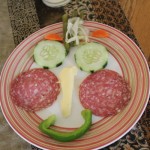
This is the kind of food character I feel good about: green pepper, cucumber, raw sauerkraut, carrot, asparagus cooked in bone broth, raw grassfed cheese and (well, this is processed) salami

Among the “proposed voluntary” recommendations are two principles for foods marketed directly to children aged 2-17.

Principle A indicates that food must contain at one ingredient that makes a “meaningful contribution to a healthy diet.” The list of “thumbs-up” options includes: fruit, vegetable, whole grain, low-fat or fat-free milk product, extra lean meat or poultry, eggs, nuts and seeds, or beans.

Clearly the word hasn’t gotten out to this group that full-fat dairy is a whole food, while reduced fat is not. As local chef, holistic health counselor and cooking instructor Monica Corrado points, out, when we eat full-fat foods, instead of processed foods, we feel more satisfied and eat less.

Principle B targets minimizing “the content of nutrients that could have a negative impact on health or weight.” On this list: saturated fat, trans fat, added sugars, and sodium.

Again, a traditional foods perspective would point out that fats are not all created equal, nor are salts. As I’ve said before, naturally-occurring whole-food fats like butter, lard, and coconut oil are beneficial for children’s bodies and brains, and real sea salt contains vital minerals. As the Weston A. Price Foundation has pointed out in its criticism of USDA dietary guidelines, the idea that fat and salt are just simply bad is a myth (which will be busted at the WAPF 2011 conference in Dallas!

We run into problems when we substitute healthy fats and mineral-rich sea salt for industrialized, factory-made fats like canola oil and refined salts. These substances are not real food once they have been stripped of their nutritional value, or are heated and processed in such a way that they have become unrecognizable to our bodies.

This anti-marketing initiative is, however, at least creating awareness, which is usually a good thing.

When an industry spends over $1.5 million a year trying to get kids to clamor for a certain cereal or snack, it might be hard to believe that it will undertake these “voluntary efforts.” But, with everyone talking about the childhood obesity epidemic, companies may just comply to look like they are doing their part, even if they keep producing food laden with sugar, dyes and chemicals — simply sans the snazzy characters to shill them.

I have so many photos of fun folks made out of real food, I think I will start a new Fun Food Friday tradition. Check back next week for another pic, whether I have a food-related item to write about or not!

Related link: FTC Guidance Documents with research and background

My article on the topic at the Washington Times Communities Family Today in my column, Reading Ingredients: Tales of a Health-Conscious Mom

Share

Food dyes: FDA misses the opportunity to help children

Wednesday, April 6th, 2011

I was so excited to hear that the FDA was taking on the issue of food dyes and considering banning them or requiring a warning label. People deserve to be protected from foods that cause such havoc in young brains.

Unfortunately, the FDA voted 8 to 6 last week not to ban artificial food dyes or to require that products containing them warn of a possible risk of ADHD.

At least the FDA recommended that further research into food dyes and hyperactive behavior is warranted. Those of us whose diets consist mostly of whole foods in their (relatively) natural states know how different our children act when they eat even refined sugar or chocolate. Add in artificial colorings, and sometimes it appears as though we have completely different children on our hands. Unfortunately, many children are exposed to these dyes on a regular basis, which means no one really knows how they might feel and act if they weren’t taking chemicals into their bodies night and day.

Before the FDA hearings, Washington Post columnist Petula Dvorak raised issues of economic disparity, pointing out that non-dyed individual yogurts cost a whole lot more than ones with dyes. For parents who follow the marketing, dyed food often goes hand-in-hand with “lunch” or “snack”-sized items emblazoned with characters and geared toward children.

Nesquik chocolate flavored milk (which contains artificial flavorings but not colorings) and Nesquik strawberry flavored milk, which contains both artificial flavorings and colorings: Red 40 and Blue 1.

Dvorak pointed out that not a whole lot of folks have the time to prepare individual servings with safe color substitutes like beet extract, even if they had the money. So a ban from the FDA would be the easiest way to get junk out of kids’ diets.

But since a ban is not on the horizon, and there also won’t be a warning label, it’s more important than ever for parents who can take the time and do have the money to consistently prepare healthy foods for their children to do so. It’s always important for the health of their children, but it sets an example so that children who know nothing different at home will at least have exposure to food that is safe. If your child learns about artificially-colored food from the girl sitting next to him with the Dora the Explorer yogurt, she can learn from him about real food.

And real food does taste good. As long as our children grow up with their palettes used to food that comes from the earth, they are less likely to develop a taste for the fake. Dvorak referenced the impracticality of coloring yogurt with beet juice, which I guess might start to seem necessary if older kids want to keep up with the Joneses. But wouldn’t it be nice if kids just stopped getting the idea that food has to look insane and if we instead just saw it as nourishing, the energy that is making up our very being? I loved how Bill Day explained this in his article in the Summer 2010 issue of Lilipoh magazine (“The World of Senses and Human Nutrition”).

How about instead of fake color, we just add more good food: antioxidant-rich fruit or even fruit-juice-sweetened jam?

Parents who understand the connections Dr. Feingold made over 30 years ago between dyes and behavior or who have read Dr. Rapp’s Is This Your Child? to see the before and after drawings of children exposed to dyes and allergens need to make sure that they don’t cave in to pressure for the neon birthday cake or the crazy colored Jello.

Ask ahead about cake or candy that might be served at a party, explaining that your child is sensitive to artificial dyes and you’re happy to bring an alternative. Offer to let the parents borrow your India Tree natural dyes made of vegetable ingredients. If asked, or if you get the right window, share suggestions of your favorite natural treats. No parent wants to feel judged or shamed, but sharing your hopes for a meltdown-free afternoon (or week, as some kids really hold onto food “hangovers”) should be appreciated if you enlist the other parents as allies. We all just want our kids to be happy and feel good, right?

And for them to grow into healthy adults. A lot of folks claim, “I ate plenty of junk food as a kid, and I turned out okay.” The problem with that argument is that junk food of the 1970s didn’t contain the amount of high fructose corn syrup (HFCS) that it does today, and today, plenty of things people think of as regular food (like yogurt) do have HFCS, and artificial colors, and artificial flavorings. So children not on whole foods diets are getting hit from all sides, all the time.

Ingredients for Yummy Earth Lemon Drops: still a lot of sugar, but no artificial colors or flavors

Giving kids chemically-altered food is not just letting them have a fun childhood. Keeping them healthy is our job, and there are plenty of ways to have fun with food that don’t require highly industrialized products.

Besides, plenty of adults are not “fine;” they have weight issues, depression or anxiety, skin problems, asthma, infertility, thyroid issues or a whole host of other problems. Food dyes are probably not a smoking gun for any one of these things, but in a holistic view, they are a likely a component.

Let’s keep both a meltdown-free day and a healthy adulthood in mind when we choose what to put in our children’s mouths and on their skin, which “eats” 80% of what we put on it!

See the full list of ingredients in Nesquik’s strawberry flavored milk.

Share

New food labels tell only part of the story
Friday, January 28th, 2011

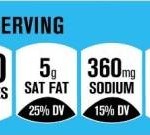
Proposed format for new front-of-package labels

If the food industry has its way, shoppers will soon see an at-a-glance view of a product’s nutritional profile on the front of the package, separate from the complete nutritional information. The mini-profile will list the calories, fat grams, milligrams of sodium, and grams of sugar in big numbers (sometimes with a highlighted important “nutrient” noted).

Taken out of context, details like fat grams are not helpful. If fat comes from almonds, for example, great. Fat from a manufactured product like canola oil is a different story.

This new labeling scheme will be like trying to get somewhere only by reading the speed limit sign but not actually consulting a map.

The labels, promoted by the Grocery Manufacturers Association, will show grams and also the percentage of the daily value allowed it accounts for. Even if the Food and Drug Administration does not approve of this labeling scheme, it’s still the  USDA’s problematic nutritional guidelines that will be informing the labels.

The government doesn’t consider the source or the complexity of each ingredient as much as the raw number.

Sugar grams that come all from whole fruits, or even whole food sweeteners like honey or molasses – with their fiber and minerals intact – don’t wreak the same havoc on the body as sugar grams from refined sugars. Fat grams from coconut oil are not bad, while fats from partially hydrogenated oils are. So two foods with labels of 5g fat might have vastly different nutritional profiles.

Even though the numbers don’t tell the whole story, it does sound like this scheme isn’t quite as troubling as the Smart Choices program which gave a green check-mark to Froot Loops despite the fact that over 40 percent of the cereal by weight is sugar. According to the Washington Post article on the number labels, Smart Choices was abandoned in 2009 after it was “widely panned by public health advocates and the FDA.”

Even if Froot Loops hadn’t gotten a seal of approval, I still chafe at the idea of someone deciding what is good and bad and giving any kind of thumbs up or down. I mean, at least with the GMA’s new label, I can look at the fat grams and decide for myself that a high number might be good. Smart Choices tries to tell you what conclusion to draw.

Regardless of what new packaging icons come down the line, the only way to really know about a product is to read the entire label.

Or just buy real foods that don’t have labels!

I wrote more about this and other recent food-related health news in this column at the Washington Times Communities.

Share